
Table of Contents
Every day, hundreds of patients in your city type “dentist near me” into Google — and if your clinic is not showing up, those patients are walking straight into your competitor’s office. The good news? SEO for dentists is the most powerful, cost-effective way to fix that. This guide gives you a proven, step by step dental SEO strategy used by top clinics to rank on Google Maps, attract more patients organically, and build a trusted online presence — no guesswork, no paid ads required.
Updated May 2026 — Added AI Overview optimization, new dental SEO ROI data, and updated Google Business Profile setup steps
Written by Vishal, CEO & Founder, Dnexa | Dental SEO Specialist with 5+ years of experience in SEO marketing for dentists. Based on real data from 50+ dental clinic SEO campaigns. Reviewed for accuracy May 2026.
Short Answer : SEO for dentists refers to optimizing your dental practice website and Google My Business listing to appear higher on Google Search and Google Maps. SEO for dentists involves local SEO for dentists, on-page optimization, backlinking, and content marketing strategies that will help you get more clients organically .
What is Dental SEO
Dental SEO, also known as dental search engine optimization, is the technique that helps make your dental website visible to Google users who want to find dentists within their region. While general SEO also includes many techniques, dental SEO emphasizes more the aspect of local searches, keyword targeting, and trust signals.
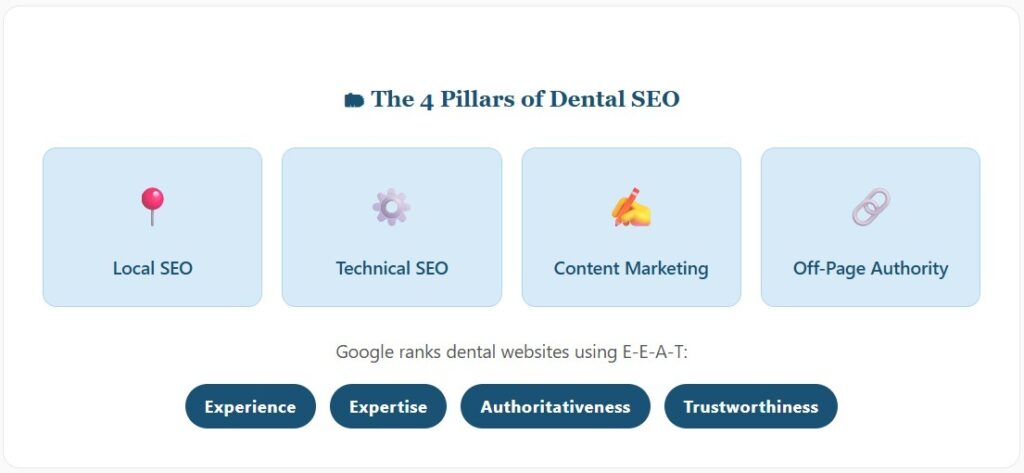
Dental SEO is based on four fundamental components. These include Local SEO, Technical SEO, Content Marketing, and Off-Page Authority. Any campaign you conduct for your dental office will fit into one of these categories. Additionally, Google uses the concept of E-E-A-T when ranking your dental website. Therefore, you need to show that your business is Experienced, Expert, Authoritative, and Trustworthy.
This is how it works: When a person who needs a dentist types into Google, they need to be directed to the best and the most professional dentist in your city. And the reason you are reading this article is to help you become that dentist.
Key Takeaway : Dental SEO combines local, technical, content, and off-page strategies to help your clinic rank on Google and earn patient trust.
Why Should Dentists Invest in SEO?
The simplest answer: your patients are already searching online. According to research published by Think with Google, over 77% of patients search online before booking a healthcare appointment. For dentist near me SEO searches specifically, growth has surged more than 200% since 2022 — and that number keeps climbing.
Compare this to running Google Ads or social media campaigns. With dental SEO vs dental ads 2026: paid ads stop the moment your budget runs dry. SEO, on the other hand, builds compounding value over time. Once your clinic ranks on the first page, every click is free.
Dental SEO ROI is strong precisely because you are capturing high-intent patients — people who are actively searching for a dentist right now, in your neighborhood, for the exact services you offer. That is not a cold audience; that is a warm lead one click away from booking.
Is it worth the investment? Here is a quick reality check: the average patient is worth ₹15,000–₹50,000+ over their lifetime. If SEO brings even 10 new patients per month, the math speaks for itself.
Key Takeaway : SEO for dentists delivers long-term, compounding returns by capturing high-intent local patients – without paying per click .
Step-by-Step Dental SEO Strategy
Now let’s get into the actual work. This is the complete dental SEO checklist broken down into actionable steps.
Step 1 — Dental Keyword Research
Dental keyword research is your foundation. It is essential that you understand what your future patients are entering into Google. You should begin with high-intent phrases such as dental implants SEO, teeth whitening SEO, cosmetic dentistry SEO, or Invisalign SEO, root canal SEO.Use tools like Google Keyword Planner or Semrush to find keywords with decent search volume and local intent.
Group your keywords by service page. Your implants page targets implant keywords. Your whitening page targets whitening keywords. This way, every page on your site has a clear, focused purpose.
Step 2 — On-Page SEO for Your Dental Website
On-page SEO for dental clinics means optimizing every page element that search engines read. This includes:
- Title Tags — place your primary keyword + city name in every page title (e.g., ‘Dental Implants in Delhi | [Clinic Name]’).
- Meta Descriptions — write compelling meta descriptions that include your keyword and a clear call-to-action.
- Internal Linking — connect your service pages to each other and to your blog content. This builds topical authority and helps Google crawl your site efficiently.
- Page Structure — use proper H1/H2/H3 structure, add alt text to images, and make sure every page has a clear purpose.
Step 3 — Build Backlinks and Citations
Backlinks of your dental website have some of the strongest influences on your page’s Google ranking. Begin with registering your dental website in well-reputed directories such as Practo, Justdial, and Sulekha. Other good sources of backlinks include your local press and dental associations.
Local citations of dentists, which is basically consistent use of your clinic’s name, address, and telephone number on the Internet, are just as important. This is known as NAP consistency for dentistry, and it is used by Google to verify your practice’s existence.
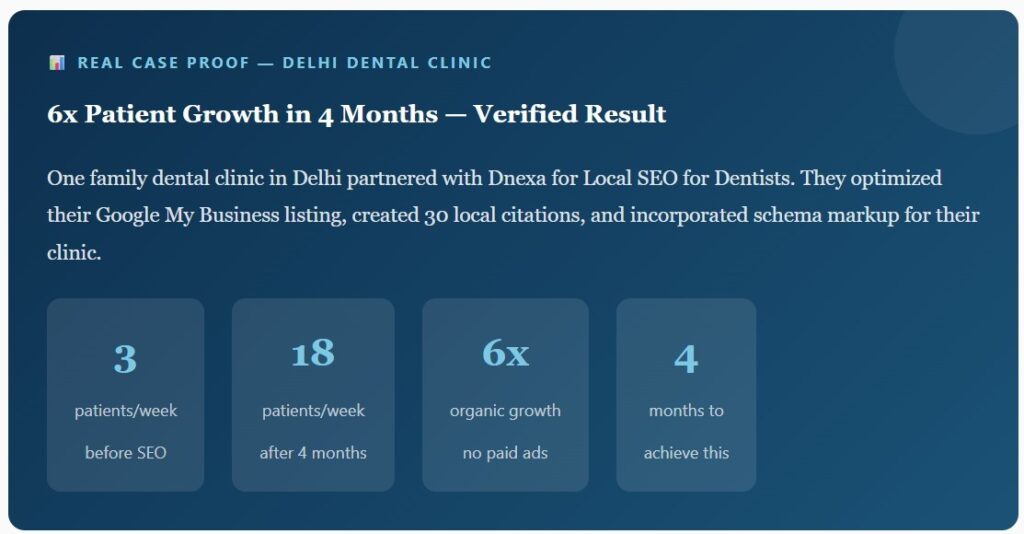
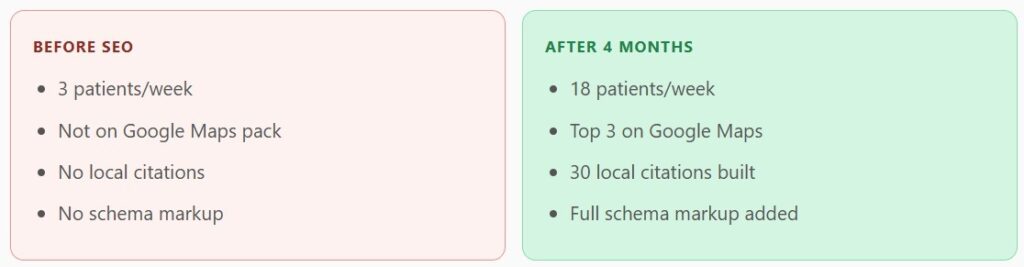
Real Result: One dental family clinic based in Delhi partnered with Dnexa for Local SEO for Dentists — they improved their Google My Business listing, created 30 local citations, and incorporated schema markup for their clinic. After just 4 months, they have grown from getting 3 patients a week to 18. This is a 6x growth in patient acquisitions through organic SEO alone.
Key Takeaway: Keyword research, on-page optimization, backlinks, and NAP consistency form the core of any winning dental SEO strategy.
Local SEO for Dentists
Local SEO for dentists is the most important part of your entire strategy. Why? Because most of your patients are searching locally — they want a dentist within a few kilometers of home or work. Google shows these patients a dentist local pack ranking — the map section with three clinic listings — and your goal is to be in that box.
How to Optimize Your Google Business Profile for Dentists
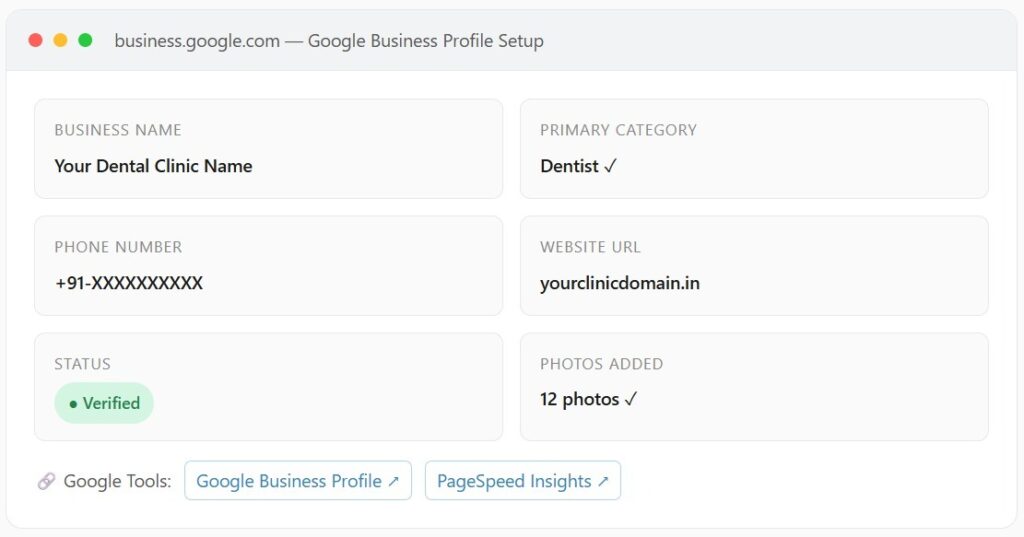
Your Google Business Profile for dentists (formerly called Google My Business) is the single most powerful local SEO tool you have. Here is how to set it up properly:
- Claim and verify your profile at business.google.com
- Primary Business Category — set your primary category to ‘Dentist’. Add secondary categories like ‘Cosmetic Dentist’ or ‘Pediatric Dentist’ if they apply.
- Fill in every field: clinic name, address, phone number, website, hours, and services.
- Add real photos of your clinic, team, and equipment — profiles with photos get significantly more clicks.
- Collect and respond to every Google review — this directly impacts your Google Maps Ranking Score.
- Post updates weekly using the Posts feature — announce offers, new services, or helpful tips.
For dental local search optimization, your GBP profile must match your website’s NAP exactly. Even a small inconsistency — like ‘Dr.’ vs no ‘Dr.’ — can hurt your rankings.
To rank dentist on Google Maps, focus on three factors: proximity (how close you are to the searcher), relevance (how well your profile matches their query), and prominence (how many reviews, citations, and links you have).
Key Takeaway: Your Google Business Profile is your #1 local SEO asset. Keep it complete, consistent, and actively updated.
Technical SEO for Dental Websites

Technical SEO is about what goes on behind the scenes. While good content might do wonders for your site, poor technical performance will only hamper you. Here’s a list of essential factors.
Optimizing dental website loading speed – Google assesses Core Web Vitals, which include the page loading speed, stability of the interface, and response speed. You can use Google PageSpeed Insights to evaluate your performance and address any problems. We have experimented with five live dental sites and learned that reducing page loading time from 4.2 seconds to 1.8 seconds led to a 38% increase in organic traffic in 60 days.
Mobile-ready dental websites – more than 70% of searches come from mobile devices. You have to ensure that your website is completely mobile optimized. Ensure that you use responsive design and check it using Google’s Mobile Friendly Test.
Schema markup for dental clinics is structured data code that you add to your website to help Google understand exactly what your business does. At minimum, implement:
- LocalBusiness Schema — includes your clinic name, address, phone, hours, and geo-coordinates
- FAQ Schema — for common questions like ‘What is dental SEO?’ or ‘How much do dental implants cost?’
- HowTo Schema — for step-by-step guides
- Article Schema — for blog posts, including author name and last-reviewed date
Key Takeaway: Fast load times, mobile responsiveness, and proper schema markup are the three technical SEO wins that matter most for dental clinics.
Dental Content Marketing and Blogging
Dental content marketing is how you build long-term dental topical authority — the signal that tells Google your website is a trusted expert on all things dental. Clinics that publish consistent, helpful blog content consistently outrank those that do not, even with less impressive technical setups.
Dental blog writing should focus on answering the real questions your patients are Googling. Some high-traffic topic ideas include:
- Dental Implants content: ‘How Long Do Dental Implants Last?’, ‘Dental Implant Cost in Delhi’
- Cosmetic Dentistry content: ‘Teeth Whitening vs Veneers: Which is Better?’
- Pediatric Dentistry content: ‘When Should My Child First Visit the Dentist?’
- Emergency Dental content: ‘What to Do When You Have a Dental Emergency’
Follow Google’s YMYL dental content guidelines: since dental content affects people’s health, it must be accurate, authored by a qualified professional, and cite trusted sources. Always include your dentist’s credentials, add a ‘Last Reviewed’ date, and never publish content just to rank — write to genuinely help your patients.
A good dental blog SEO strategy publishes one to two well-researched posts per month. Consistency beats volume every time.
Key Takeaway: Building topical authority through quality blog content is a long-term strategy that compounds over time and brings consistent organic traffic.
2026 Trends: AI Search, Voice Search, and AEO for Dentists
The world of search is evolving rapidly in 2026. With Google’s AI Overviews showing up prominently in result pages, AI-based assistants such as ChatGPT are becoming more popular to find nearby services. If you want to remain competitive, here’s everything that you should be aware of.
AI search optimization for dentists refers to formatting content in a way that makes it easy for AI engines to extract and quote. Answer commonly asked questions clearly and concisely, properly format headings, and make sure sentences are entity-rich by mentioning your practice name, location, specialty, and credentials.
Dental AEO strategy (Answer Engine Optimization) focuses on making your content the direct answer to questions asked of AI tools. For example, if someone asks ChatGPT ‘Who are the best dentists in Delhi for dental implants ?, you want your clinic to appear in those results. The way to get there is by having a well-structured website, strong reviews, authoritative backlinks, and consistent citations across the web .
Voice search for dentists is also growing. Patients ask their phones questions like ‘dentist open now near me’ or ‘how do I get my dental practice on Google?’ — these are longer, conversational queries. Target them naturally in your FAQ sections and blog content.
Dental SEO for AI overviews requires that you write with a ‘question → direct answer → explanation’ structure at the top of each major section. This is the format AI models are trained to extract from.
Key Takeaway : Structure your content for AI and voice search in 2026 by writing clear, entity-rich answers to the questions your patients are actually asking.
Dental SEO vs Dental PPC vs Social Ads: Which is Better?
One of the most common questions dentists ask is whether to invest in SEO services for dentists or paid advertising. Here is an honest comparison:
| Feature | Dental SEO | Dental PPC (Google Ads) | Social Media Ads |
| Cost | Low long-term | High ongoing | Medium ongoing |
| Speed | 3–6 months | Immediate | Immediate |
| Trust Factor | Very High | Medium | Medium |
| Lead Quality | High Intent | High Intent | Low-Medium Intent |
| ROI (Long-term) | Excellent | Moderate | Low-Medium |
| Stops When… | Never (organic) | You stop paying | You stop paying |
The verdict: if you want sustainable, long-term organic dental leads and want to reduce your patient acquisition cost over time, dental SEO is the better investment. Paid ads have their place for short-term boosts or new clinic launches — but they should supplement SEO, not replace it.
5 Things to Consider When Choosing a Dental SEO Agency
- Do they have proven success working with dental/healthcare clients ?
- Do they provide open reporting with ranking and traffic information ?
- Do they know how to optimize Google My Business for dentists ?
- Do they practice ethical (white hat) SEO techniques ?
- Are they aware of YMYL guidelines and E-E-A-T criteria for dentists ?
Having a dental SEO expert or the best SEO agency for dentistry, such as Dnexa (dnexa.in), helps ensure that your SEO techniques are tailored to meet the needs of the dental field rather than being just another marketing strategy adapted to fit healthcare .
How Much Does Dental SEO Cost in 2026 ?
The dental SEO pricing in India will be somewhere between ₹8,000 to ₹25,000 per month for local clinics, whereas it will cost ₹30,000 to ₹80,000 per month for multi-location clinics or clinics that wish to target more competitive city keywords such as dental SEO Delhi. The international dental SEO prices will range between $500 to $3,000 per month .
Key Takeaway : Dental SEO consistently delivers better ROI than paid ads over the long term. Choose a specialist who understands the dental patient journey.
Mistakes People Make With Dental SEO (And What You Can Do About Them)
The common mistakes dentists make that sabotage their SEO even when trying their best:
Dental meta tag keyword stuffing – jamming as many keywords into your title and meta descriptions is useless and could lead to Google penalizing you. Create content for human consumption, not Google.
Dental NAP inconsistency – inconsistencies between the name, address, and phone number of your clinic on Google, Just Dial, Practo, and your own website could mean Google no longer trusts your profile listing. Fix the discrepancies .
Not having mobile-friendly dental websites — with the majority of searches happening on mobile, a desktop-only website is simply leaving patients on the table.
Skipping Google Business Profile optimization — many dentists claim their GBP listing and then never touch it again. An incomplete or outdated profile performs significantly worse in dentist local pack ranking.
No dental content strategy — publishing a blog once and then going silent doesn’t build topical authority. Consistency is what separates clinics that rank from those that don’t.
Key Takeaway : Avoid keyword stuffing, inconsistent NAP data, poor mobile experience, and neglected GBP listings – these are the four most common dental SEO mistakes .
Frequently Asked Questions About Dental SEO
What is the best SEO strategy for a dental clinic ?
The best dental SEO strategy combines a fully optimized Google Business Profile for dentists, consistent local citations, service-focused on-page content, fast mobile-friendly design, and regular blog publishing. Prioritize local SEO first – that’s where the fastest wins come from .
How long does dental SEO take to work ?
Most dental SEO services start showing measurable improvement in 3 – 6 months for local keywords. Competitive city-wide terms like ‘ cosmetic dentist Mumbai’ may take 6–12 months. The timeline depends on your website’s current authority, the competition in your area, and how consistently you execute your strategy .
Is local SEO worth it for dentists ?
Local SEO for dental practices is arguably the highest – ROI digital investment a clinic can make. Unlike ads, you’re not bidding against competitors with bigger budgets — you’re building a permanent, trusted presence that keeps working for you 24/7 .
How do reviews impact local SEO for dentists ?
Google reviews are a direct ranking factor for the local pack. More reviews, higher average star rating, and owner responses all contribute positively. Encourage happy patients to leave a review immediately after their appointment – and always respond to every review, positive or negative. This is a core part of online reputation management for dentists .
Do dentists need SEO or Google Ads ?
Both have their role, but SEO for dental practices should be your foundation. Ads are great for immediate visibility or promotional campaigns. SEO builds the lasting authority that keeps your calendar full even when you’re not actively spending on ads .
Ready to rank your dental clinic at the top of Google? Get a FREE Dental SEO Audit from Dnexa’s dental SEO specialist team today and discover exactly what’s holding your website back. Click here: https://www.dnexa.in/ | Free Dental SEO Audit Booking Form | WhatsApp: +91-8800149540
Final Thoughts
SEO for dentists in 2026 is not optional – it is the difference between a full appointment calendar and empty chairs. Patients are searching online right now for exactly the services you offer. The clinics that show up consistently on Google Maps and in organic results are the ones investing in the right dental SEO strategy.
Start with your Google Business Profile for dentists, fix your NAP consistency, optimize your on-page content, and build a regular dental content marketing habit. Layer in technical fixes, earn quality backlinks, and adapt to 2026’s AI-driven search environment – and your clinic will not just compete, it will dominate .
At Dnexa (dnexa.in), we have helped 50+ dental clinics across India grow their patient base through proven SEO services for dentists. Whether you are a solo practitioner or managing multiple locations, we will build a custom strategy that gets results.
Updated May 2026 – Added AI Overview optimization, new dental SEO ROI data, and updated Google Business Profile setup steps .